

A customer searching for a local business in Delhi may make a decision before ever calling, visiting the website, or walking through the door. They might see a Google Business Profile, scan recent reviews, look at photos, check the business’s website and compare it with nearby competitors.
Imagine two dental clinics in South Delhi offering similar treatments. One has hundreds of recent reviews, detailed feedback from patients and professional responses from the clinic. The other has several unanswered complaints and outdated business information. Even if both clinics provide similar services, the first may create more confidence during that initial search.
This is why online reputation matters to local businesses. Your reputation is not limited to what you say about your company. It is also shaped by what customers can find, read and verify about you online.
For businesses in Delhi, where customers have plenty of local alternatives, maintaining that reputation can be an important part of winning trust and generating enquiries.
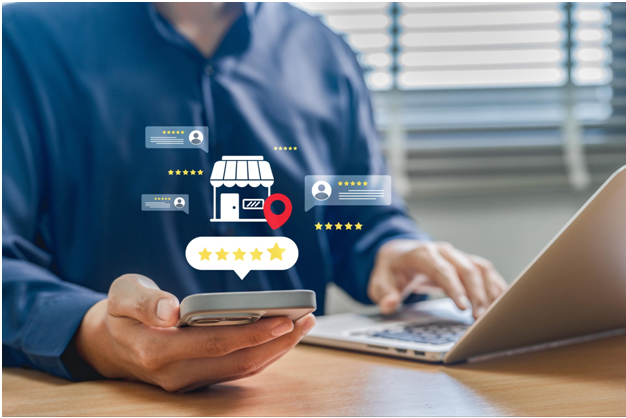
What Does Online Reputation Actually Include?
Online reputation is the overall impression people form about a business based on its online presence and the experiences shared by others.
It can include:
- Google Business Profile information
- Customer reviews and ratings
- Responses to reviews
- Social media comments and discussions
- Brand mentions on other websites
- Business directory information
- Search results for the company name
- Customer-generated photos and experiences
- The company’s own website and published content
Online reputation management, or ORM, brings these activities together through ongoing monitoring and response.
It is important to understand that ORM is not simply the process of removing negative reviews. A genuine complaint may point to a real problem that needs to be fixed. Managing reputation effectively means understanding what customers are saying, responding appropriately and improving the experience where necessary.
What Happens When Someone Searches for Your Business?
Local customers often have several options available to them. A search can quickly put your business alongside competitors, allowing someone to compare ratings, reviews, locations, services, photographs and other information.
The customer may ask questions such as:
- Does this business have good reviews?
- Are the reviews recent?
- Does the business respond to customers?
- Do several customers mention the same problem?
- Does the business information look accurate?
- Does the website appear professional?
- What do other customers say about their experience?
The answers can influence whether the person contacts you or moves on to another business.
This matters particularly for businesses where trust plays a major role in the purchase decision. A person choosing a dentist, doctor, lawyer, real estate agent, restaurant, salon or home-service provider may want reassurance before spending money or committing to an appointment.
Reviews Are Often Part of a Wider Research Process
Customers do not necessarily look at just one review platform.
BrightLocal’s 2025 Local Consumer Review Survey found that 74% of consumers use two or more websites when researching reviews for local businesses. The survey included 1,026 US adult consumers, so this figure should not be interpreted as a statistic specifically about Delhi customers. It does, however, demonstrate that local reputation research can extend across multiple online sources.
The same survey found that 42% of consumers said they trust online reviews as much as personal recommendations from friends and family in 2025. That figure was 79% in 2020.
The change is worth paying attention to.
People may read reviews, but they can also question whether the feedback is genuine, current or relevant to their own situation. This means businesses should focus on the quality and authenticity of their customer feedback rather than simply trying to increase the number of five-star ratings.
A detailed review describing an actual experience can provide much more context than a rating with no explanation.
Your Google Business Profile Can Shape the First Impression
For a local business, Google Business Profile is often one of the most visible representations of the company online.
A potential customer may see your:
- Business name
- Category
- Location
- Opening hours
- Website
- Photos
- Reviews
- Review responses
- Other business information
before visiting your website.
Google recommends keeping business information complete and accurate and responding to customer reviews. Google also explains that local search results are primarily based on relevance, distance and prominence.
Importantly, Google states that more reviews and positive ratings can help a business’s local ranking. That does not mean reviews guarantee a particular position in Google Maps. Local visibility depends on several factors.
The practical takeaway is simpler: your Google Business Profile should not be treated as a static listing. It is part of the way customers discover and evaluate your business.
A High Rating Is Not the Whole Story
It is tempting to judge online reputation by looking at the star rating alone.
But consider two businesses with a 4.5-star rating.
Business A has hundreds of recent reviews containing specific comments about service quality. The owner responds to both positive and negative feedback.
Business B also has a 4.5-star rating, but most of its reviews are several years old and recent complaints have received no response.
The numerical rating is similar, but the impression can be very different.
Customers may look at:
- How recent the reviews are
- How detailed they are
- Whether customers mention consistent strengths or problems
- How the business responds
- Whether complaints are repeated
- Whether photographs appear genuine
- Whether business information is consistent
Reputation is therefore about patterns and context, not simply achieving a particular star rating.
How Should a Delhi Business Handle Negative Reviews?
Not every negative review requires the same response.
Genuine service complaint
Acknowledge the concern, avoid becoming defensive and investigate what happened.
Misunderstanding
Clarify the situation politely without turning the response into an argument.
Repeated complaint
Look beyond the individual review. If several customers mention the same problem, investigate the underlying process.
Suspected fake review
Do not publicly accuse the reviewer without evidence. Document the issue and use the relevant platform’s reporting process if the content violates its policies.
Sensitive complaint
Avoid discussing private customer details publicly. Invite the customer to continue the conversation through an appropriate private channel.
The goal of a review response is not simply to convince the reviewer to change their rating. Anyone reading the response can also form an opinion about how the business handles criticism.
An 8-Point Online Reputation Audit
A business owner can perform a basic reputation check without complicated software.
Search your business name and ask:
- What appears on the first page of Google?
Look at the search results from a potential customer’s perspective.
- Is your Google Business Profile accurate?
Check the address, phone number, opening hours, website and services.
- What are customers saying recently?
Don’t look only at your overall rating. Read recent reviews.
- Are negative reviews receiving appropriate responses?
Check whether complaints have been acknowledged professionally.
- Are customers repeating the same complaint?
Repeated feedback may point to an operational issue.
- What happens when you search the brand on other platforms?
Look at relevant review websites and social media platforms.
- Are your business details consistent?
Check important directories and profiles for outdated information.
- What would a first-time customer think?
This final question is often the most useful. Ignore your knowledge of the business for a moment and judge the online presence as a stranger would.
Reputation Management Should Start With Customer Experience
There is a limit to what reputation management can achieve if the underlying customer experience is poor.
If customers repeatedly complain about late appointments, slow responses, poor communication or service quality, writing better review responses will not solve the root problem.
Businesses should therefore treat reviews as a source of customer feedback.
For example, if ten customers independently mention that enquiries take several days to receive a response, that pattern is more useful than treating each review as a separate reputation problem.
The business can improve its response process, communicate expectations more clearly and then monitor whether future feedback changes.
This approach makes reputation management part of business improvement rather than simply online damage control.
When Is Professional ORM Worth Considering?
A small business with a handful of reviews may be able to manage its reputation internally.
The challenge grows when a business has multiple locations, receives a large volume of reviews or has conversations about its brand appearing across several platforms.
Professional ORM support may be worth considering when a business is dealing with:
- A high volume of customer reviews
- Repeated negative feedback
- Suspicious or potentially fake reviews
- Negative search results for the brand
- Multiple business locations
- Reputation-related social media activity
- Inconsistent information across platforms
- Limited staff available to monitor online mentions
For businesses that need structured monitoring, review management and reputation support, Sandeep Mehta’s ORM Services in Delhi can be considered as part of a broader reputation strategy.
The service itself, however, should not replace the fundamentals. Businesses still need accurate information, genuine customer feedback, good service and professional communication.
Online Reputation Is an Ongoing Business Activity
Online reputation is built through hundreds of small interactions rather than one marketing campaign.
A customer leaves a review. Someone else searches the business name. A potential customer reads an unanswered complaint. Another customer shares a positive experience. Over time, these individual signals contribute to the impression people form about the business.
For Delhi’s local businesses, the practical approach is to treat reputation as an ongoing activity:
Monitor → Understand → Respond → Improve → Measure → Repeat
The businesses that take this approach are not simply trying to look good online. They are making it easier for potential customers to find accurate information, understand what existing customers experienced and make a more confident decision.